
Japan has design, Sweden has design, but India stopped at heritage.
How changing the context, not the content, might be how India finds its modern design language.

I spent this weekend helping a friend do up her apartment. We measured the windows, bought fabrics for the curtains, ordered and returned two coffee tables because the finish on the actual product was nothing like what we’d seen online, and lost an entire Saturday deciding whether the console should sit against the east wall or the north one. The apartment is rented. She has maybe two years left on the lease, if that.
It’s a funny thing about our generation, how we’ve all reached the age where everyone is doing up homes they don’t technically own like they’re planning to hand them down to their kids one day. Rented flats, PG rooms, the “temporary” set up that’s been temporary for four years now, all of it gets the full treatment, moodboards and return policies read twice and a group chat dedicated entirely to whether the sofa should be bouclé or not.
I’m not saying this to make fun of it, because I do the exact same thing, every place I’ve ever lived in, whether I was there for two months or five years, I’ve done it up like I was going to stay forever. I think it’s because where you live isn’t just where you sleep, it’s what nourishes you every single day, it shapes your day, whether you clock it or not, and in every one of those spaces I have lived, without fail, there’s always been a carpet.
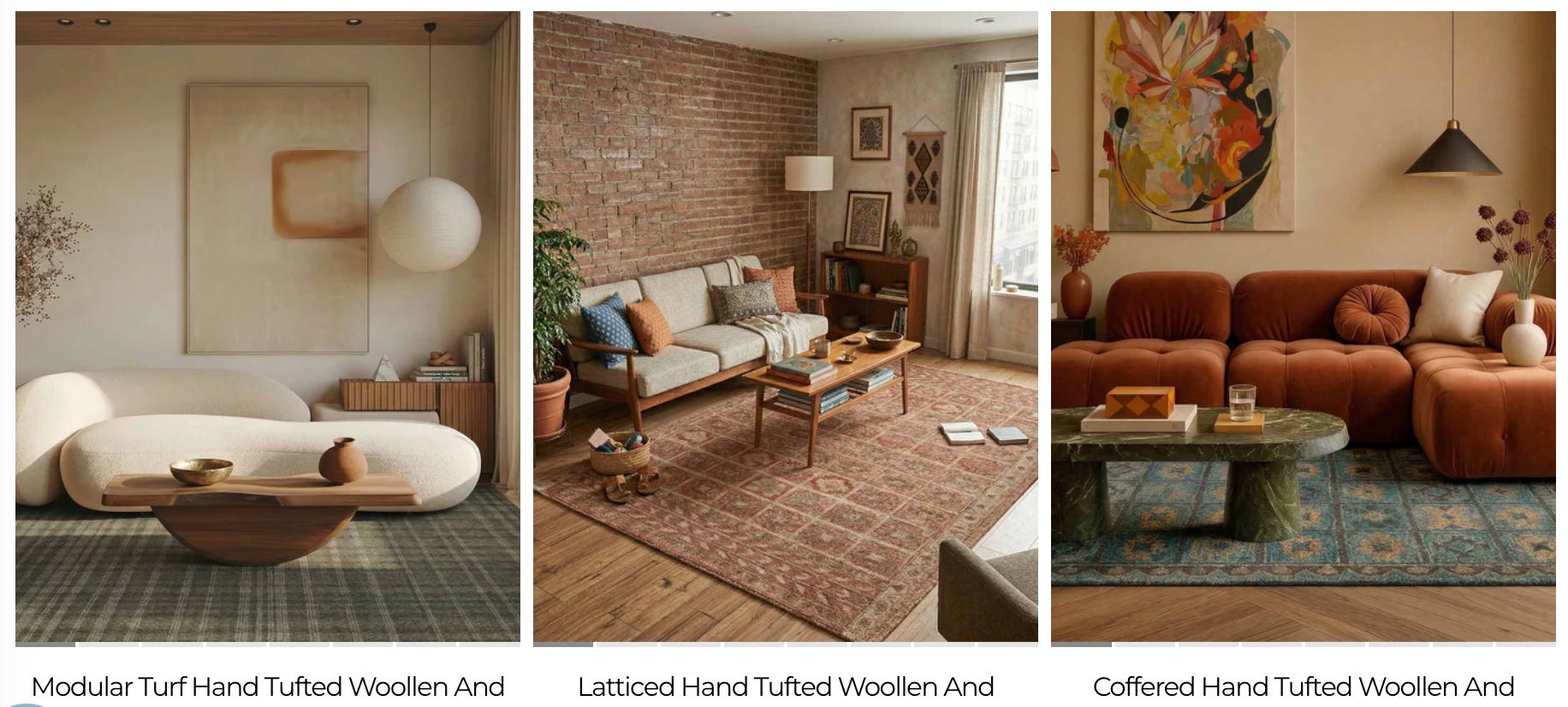
I think it comes from growing up in a Muslim household, where the floor was never really just the floor. Namaz happens on the ground, five times a day, so the ground has to be clean and soft and worthy of your forehead touching it, which is probably why our house was carpeted, and I mean properly carpeted, corner to corner in every room, the kind that’s an absolute nightmare to keep clean and an even bigger nightmare to replace. My mother will tell you this at length, and with some lingering resentment, about all the hours of her life that have gone into beating dust out of those carpets on the balcony railing.
But it also shaped the way I look at a room. I’ve always liked floor seating; something is grounding about it, literally and otherwise, that a sofa doesn’t give you. And I’ve always treated carpets as architecture rather than an accessory, a rug was never just something that sat under furniture for me, it defines a space, draws a boundary in a room that has none, tells your eye this is where to sit, this is where the to walk, this is where you take your shoes off. However, in my house, shoes are always off. Honestly, I think carpets don’t decorate a room so much as they organise it.
So while I was helping my friend hunt down the right one, I of course fell down a rabbit hole, because I always do; one tab became eleven, and somewhere in that mess I landed on a brand called Obeetee and got completely stuck there.
Here’s the thing about the carpet in an Indian home: it feels ancestral, like it’s been here forever, but it’s actually a five-hundred-year-old immigrant.
Carpet weaving as we know it in India doesn’t go back to antiquity, it goes back to Akbar. Sometime in the mid 1500s, the Mughal emperor, who by most accounts had genuinely refined taste and very little patience for a bare floor, sent for Persian weavers to come teach Indian craftsmen the art of pile carpet knotting, and set up imperial workshops, karkhanas, in Agra, Lahore, Fatehpur Sikri, and along what would eventually become the carpet belt of north India. The story goes that one of these caravans of Persian weavers, on their way to Akbar’s court, was ambushed by bandits along the Grand Trunk Road and never made it past a small town called Gopiganj, which four centuries later is still one of the beating hearts of India’s carpet industry.

What came out of that wasn’t a copy of Persian carpets, it was something new entirely. Indian weavers took the Persian medallion and border grammar and roughened it up a bit, more asymmetry, more animals, more of the natural world pushing in at the edges. Under Shah Jahan, whose taste ran toward the maximal (see the Taj Mahal), carpets got so fine that some had over four thousand knots per square inch, and a single one could take months to finish.
That lineage never really broke. Today the stretch of land running through Bhadohi, Mirzapur, and Varanasi, still called the carpet belt, produces something like 40% of the entire world’s handmade carpet exports, and not 40% of India’s, 40% of the whole world’s. Over two million people, a huge share of them women in rural Uttar Pradesh, are involved in some part of that process, carding, dyeing, knotting, washing, shearing. Seven separate carpet and dhurrie traditions across India, Bhadohi, Kashmir, Mirzapur, Agra among others, now carry Geographical Indication tags, the same legal protection that guards Champagne or Darjeeling tea, which is a strange kind of poetic justice when you think about it, a craft that arrived as an import from Persia became so thoroughly, legally, undeniably Indian that the government now protects it as a piece of the country’s identity.
And yet, despite weaving nearly half the carpets on earth, India owns almost none of the world’s carpet brands. Walk into a design store in New York or Berlin and the rug under your feet was very likely knotted by someone in Bhadohi, it just won’t say so anywhere, it’ll say West Elm, or Anthropologie, or some Scandinavian sounding name that photographs better on a swing tag. We make the object. Somebody else gets to tell its story.
Which is exactly why Obeetee stopped me mid scroll.
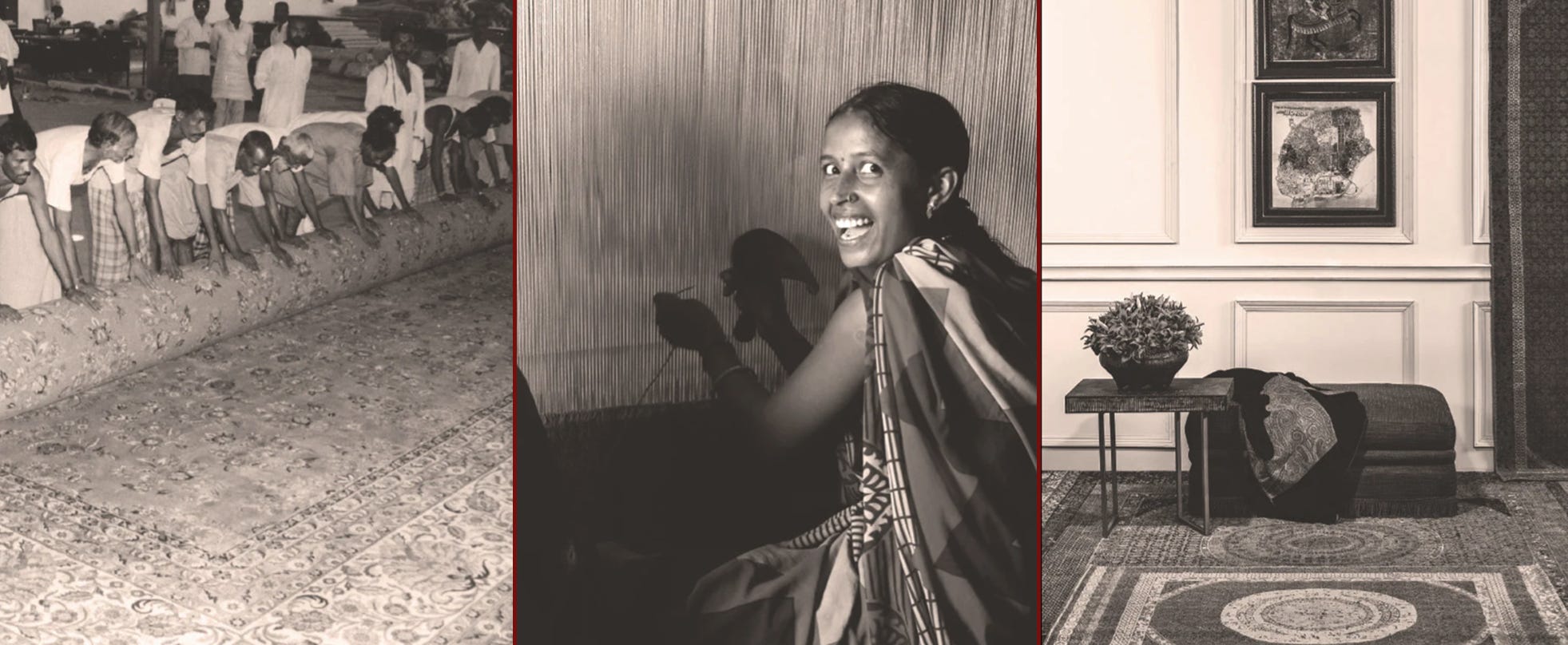
Obeetee, the name is literally the initials, O B T, of the three British men who started it, was founded in 1920 in Mirzapur, right on the banks of the Ganges, in the middle of that same carpet belt Akbar’s weavers had settled centuries before. Oakley, Bowden, and Taylor gathered the region’s finest craftsmen under one roof just after the First World War, at a moment when Indian carpets were becoming genuinely fashionable in the West, and a hundred years, several wars, and one independence movement later, it’s grown into India’s largest handmade carpet company, the kind whose rugs have sat under Nehru’s feet and inside Rashtrapati Bhavan, and which was the first company in the entire handmade carpet industry, anywhere, to earn international social accountability certification for how it treats its weavers.
I went in looking for a rug and stayed for the century of history, but what actually made me sit up straight was their newest collection, a campaign called Tokyo Chowk.
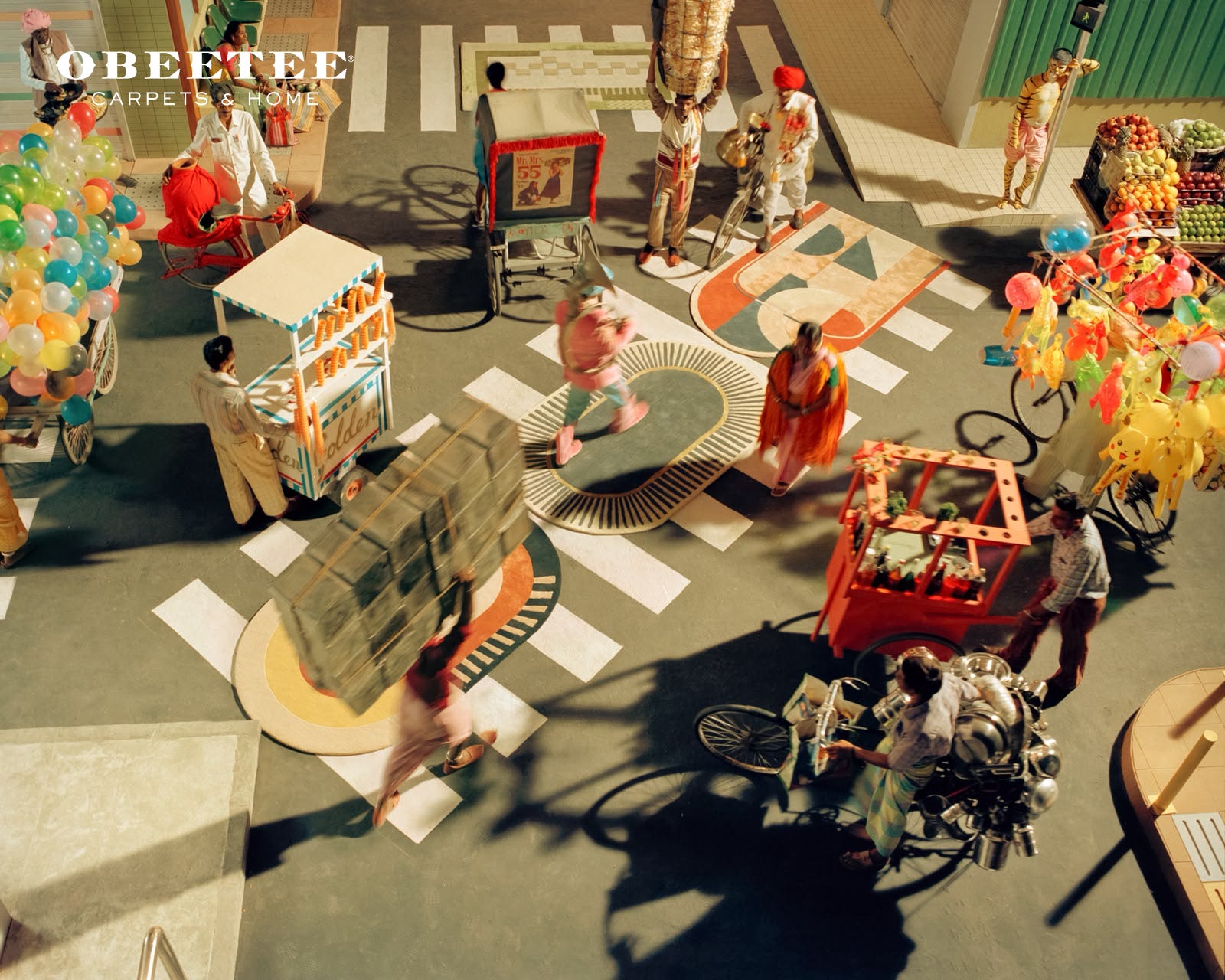
Anatomy of Tokyo Chowk
The campaign premise is disarmingly simple. Take the everyday cast of an Indian street, the bandwala, the candy floss vendor, the man on a bicycle with marigold garlands stacked shoulder high, and place them, exactly as they are, into the clean, minimal geometry of a Tokyo street. Same people, same clothes, same slightly chaotic, gorgeous, over decorated presence, just the wrong city.
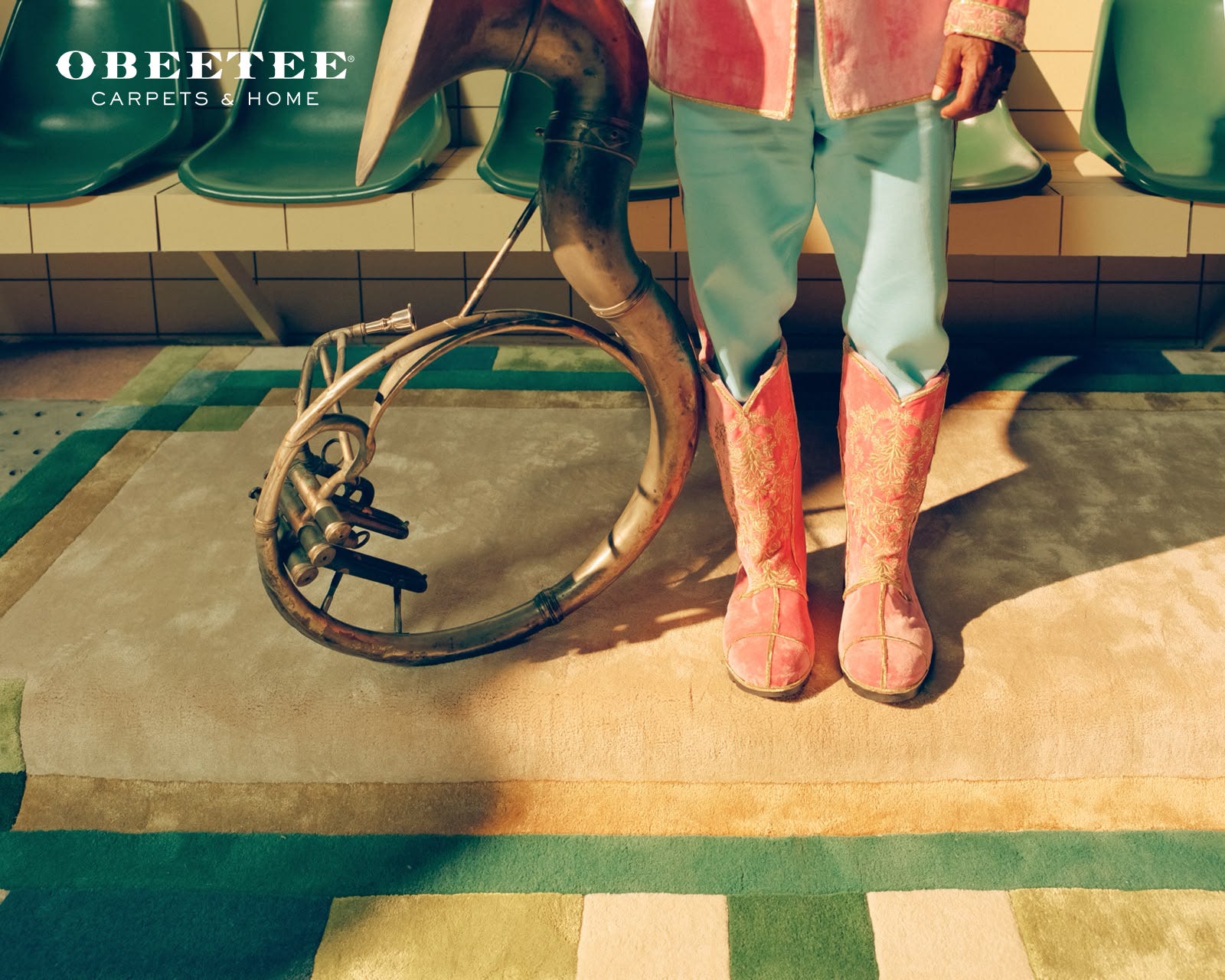
And honestly what got me wasn’t even the concept, it was what the concept did to my eyes. I caught myself staring at the bandwala’s boots like I’d genuinely never seen them before, pink with gold thread, worn soft at the toe, the kind of thing I would want for myself if I saw them anywhere else, and I never once would have clocked that if he’d been standing where he usually stands, at the edge of a wedding procession, half in traffic, half in everyone’s way.
Same with the flower basket balanced perfectly on someone's head, or the way the ice cream wala arranges his cones on the cart, all lined up at that exact same tilt, cone after cone after cone, like he's setting a table rather than selling something for twenty rupees. I've walked past that exact cart a thousand times in my life and never once thought about the geometry of it, not until I saw it framed the way you'd frame a still from a Japanese art film, all that stillness and negative space someone like Ozu or Kore eda would use on a quiet domestic scene.
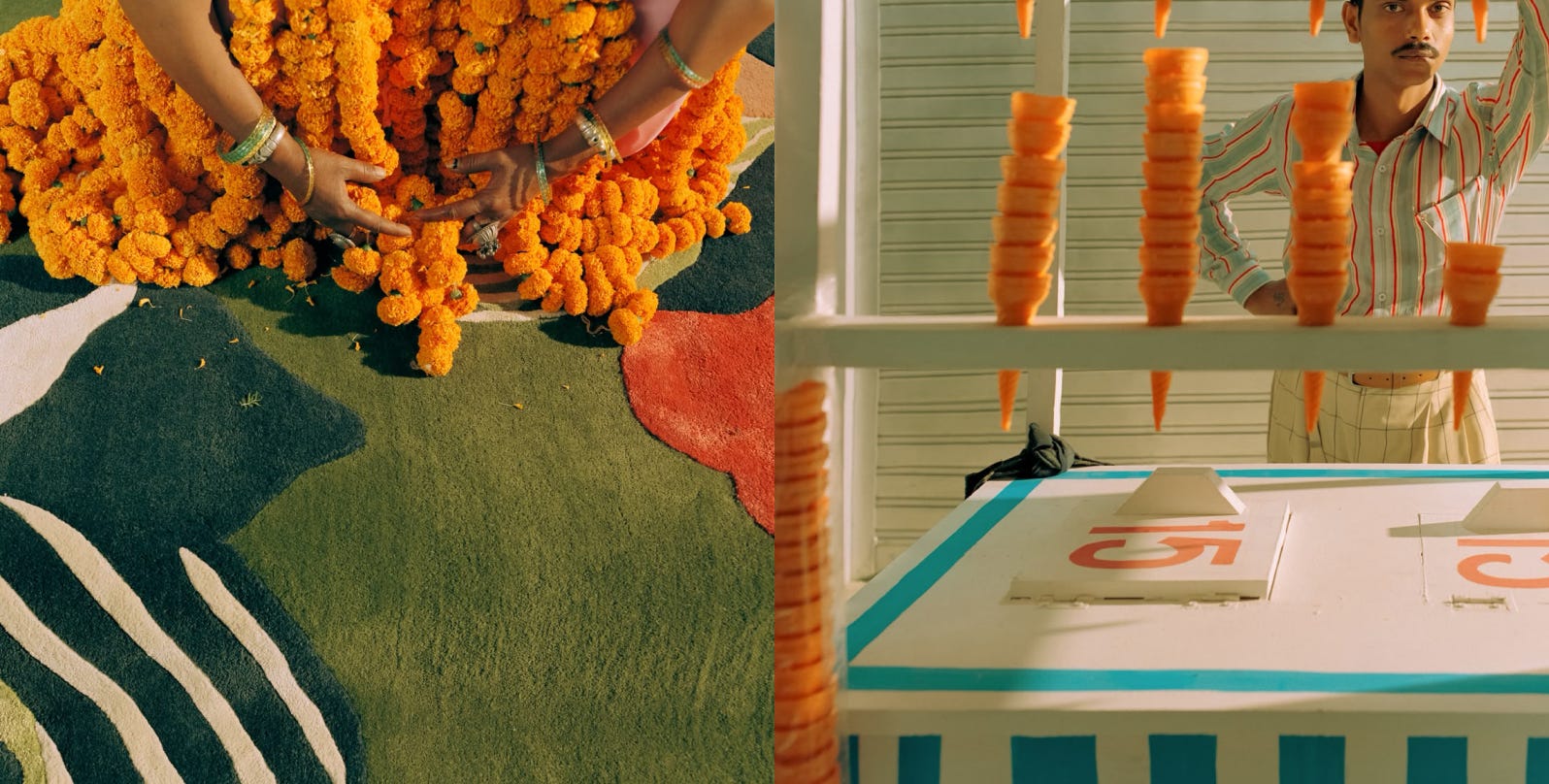
That’s the thing I keep coming back to. Nothing about the cones or flowers changed, nothing about the bandwala changed, what changed was the frame around them, and suddenly I was studying colour and proportion and texture the same way I would in a gallery. We already have the art, we’ve had it the whole time, it’s just been sitting in plain sight, worn thin from being walked past every single day. What we didn’t have was distance. Tokyo Chowk manufactures that distance, geographically and visually, and in doing so it hands us back our own eyes for a second.
And I think this is actually the more interesting story happening in Indian design right now, well beyond this one campaign. We’re in the middle of a genuine remix moment, and honestly that’s how culture actually moves forward, not by inventing something out of thin air but by taking what already exists and recombining it until something new falls out of it. It is also the way we preserve culture, taking the old and finding new ways of seeing.
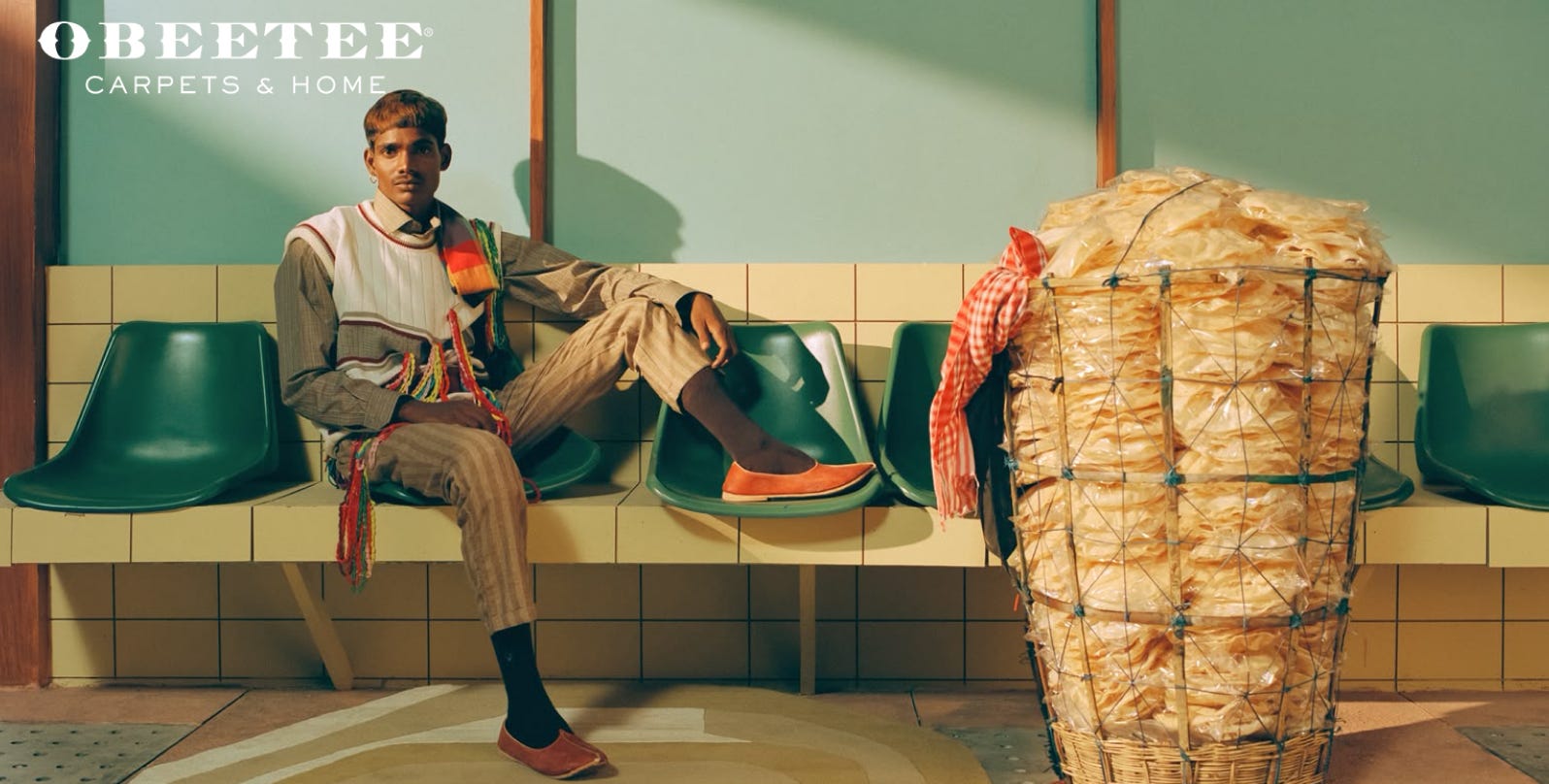
I love that so many homegrown labels are leaning into vintage matchbox art and truck typography lately, that’s a lovely instinct and a real one, but I don’t think it’s the finish line either, it’s more like one note in a much bigger scale we’re still figuring out how to play. Some of the more exciting studios I’ve come across are doing the harder version of this, mixing brutalism with Indian ornament, or Bauhaus and Scandinavian minimalism with regional craft techniques that have never once sat next to a clean grid before. None of it looks finished yet, and I don’t think it’s meant to, it’s experimentation, a lot of trial and error, in service of something that doesn’t fully exist yet, a modern Indian design language that isn’t just heritage repackaged and isn’t just borrowed minimalism either. Something that’s genuinely, newly ours.
There’s a moment in the Obeetee campaign film where you see the weavers, hands moving across the loom, cut against the same street they’ve reimagined for this whole campaign, two totally different scales of the exact same instinct. A weaver knotting a thousand individual threads into one coherent pattern is doing, quietly, the same thing a street vendor does when he stacks his cart just so, the same thing a bandwala does when he picks that particular shade of pink for his boots. Nobody sat any of them down and taught them this was design. It just is, and always has been, whether anyone was calling it that or not.
I think that’s what I actually want out of modern Indian design, the loom and the street held up next to each other without one of them getting called craft and the other getting called clutter. I don’t think we need to solve this, or land on some final, definitive Indian aesthetic and put a pin in it and call it done. I think we just need to keep looking, keep remixing, keep placing the familiar somewhere unfamiliar enough that we’re forced to actually see it again. My friend’s carpet is still not chosen, by the way, but I’ve started looking at both our homes a little differently this week, less like a floor that needs covering, more like a frame that decides what actually gets noticed.
👋 Hi, I am Fatema. I work with consumer brands on design, brand strategy and creative direction. In my weekly newsletter Layer by Layer, I peel back the layers of brand, design, and culture. If this essay made you think differently about how brands are built, subscribe, and I will see you next week.
You actually get it. This is the problem with African design everything is traditional — archival — a memory. Okay so what now. But let me read your essayyyyyx
Wow! I always thought that mix of indian aesthetic have so much potential and one more example of it is how nicobar is also doing these mixes with their products.
Thanks for giving a rationale and words to my thought ✨✨✨